


















Improving Retail and Service Interiors with Sliding Doors
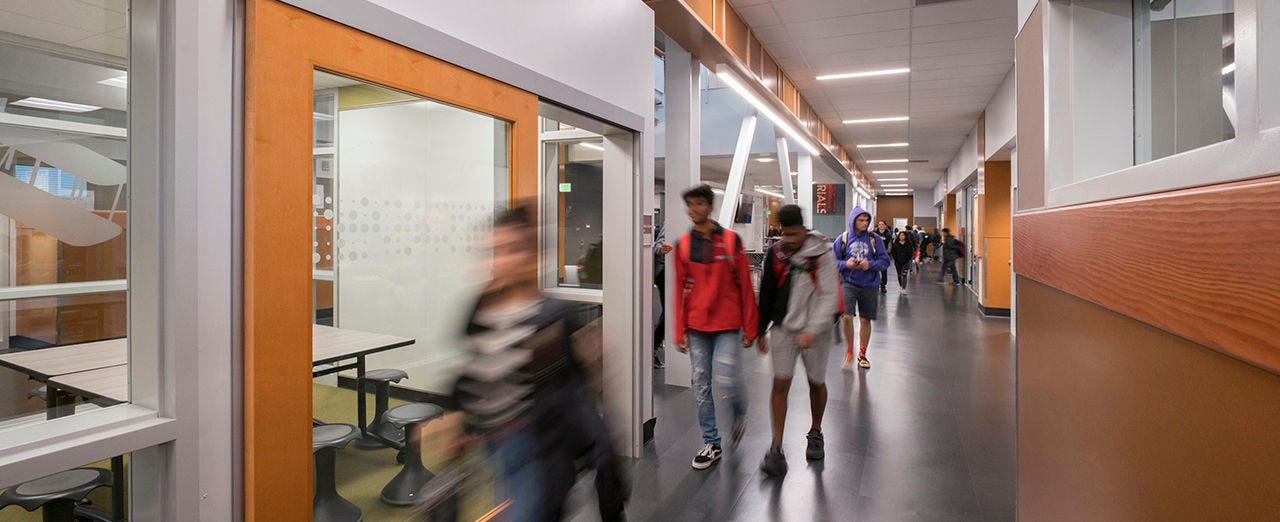
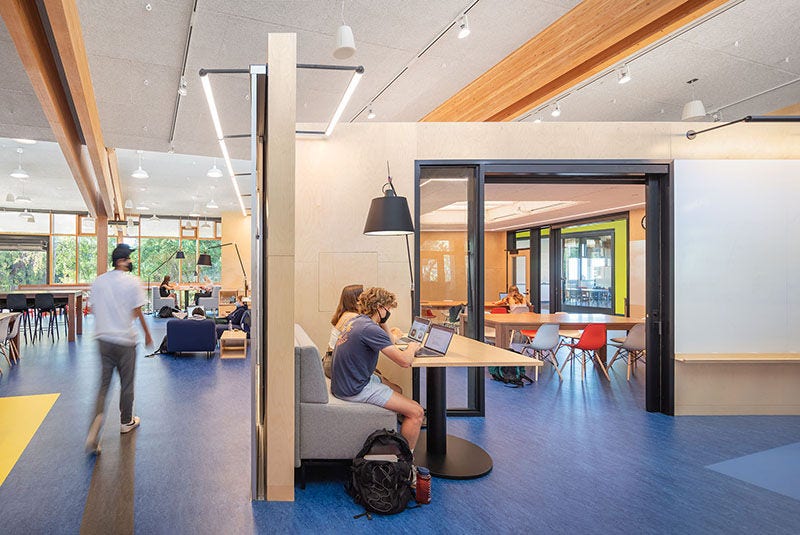
Commercial sliding doors have helped designers achieve occupant-centered designs in healthcare, education and workplace settings. Their ability to provide design flexibility, long-term durability, acoustic isolation and much more has made them integral to realizing several interrelated project goals. In fact, one architect stated, “Often architects aim high and have to settle, but these doors deliver so much value they were never value-engineered out.”
The capabilities of the commercial sliding doors can extend beyond healthcare and education settings to benefit retail and service industry projects, especially if they are a part of a retrofit. The following will look at three ways commercial sliding doors have supported design goals and how the benefits can transfer to retailer interior doors.
Improve visibility and flexibility with oversized retail interior doors
Both oversized sliding doors and telescoping systems can help create wide and flexible openings without requiring the large swing arcs typical of oversized swing doors. Further, when these doors incorporate transparent glass, they can support visual connection between spaces even when closed. These qualities contribute to project goals at the Thacher School and can allow similar designs in tenant spaces, such as storefronts with large openings in malls or other buildings.
When inside a larger structure, retailers can use oversized sliding doors to promote visual connection with common spaces, improving the ability to connect with passing customers. These doors also maximize usable floor space to improve in-store displays and navigation. When retail interior doors incorporate glass, they can convey an open and welcoming environment and encourage engagement with the store even beyond business hours.
And because commercial sliding doors can accommodate a wide range of door hardware and locking devices, they can protect retailer assets while meeting local building code requirements.
Durable perimeter frames contribute to long-term viability in service industry projects
As noted in a recent project, stout materials help ensure easier installation. They also contribute to long-term project goals by withstanding wear-and-tear, typical of both retail and service industry settings. While durable and easy-to-maintain frames and operating systems have specific benefits for building owners, these qualities can also support day-to-day operations in spaces that are leased.
For example, using commercial sliding doors with robust perimeter frames for semi-private spaces in restaurants, coffeeshops and more can reduce the cost of maintenance and upkeep since they protect the doors and the walls around them. And because operating components are tested to over 150,000 cycles, they provide business owners peace of mind that a retail interior door system will be able to meet the demands of their customers year after year.
Resilient, commercial sliding doors provide service industry settings flexible openings without having to accommodate for swing arcs. This ensures seating will not need to be rearranged if a private party is booked. When these doors also incorporate perimeter and drop-down seals, they can provide premium acoustic performance.
Acoustic isolation in mixed-use environments benefits customers
Designed with perimeter and drop-down seals, AD Systems’ commercial sliding doors offer Noise Isolation Class (NIC) ratings up to 39. This translates to being able to dampen up to 39 decibels when installed in real-world settings. Designers have used these door systems to more easily meet building and HIPPA standards in healthcare as well as provide more flexible-use spaces in educational settings. For retail interior doors, acoustic performance can contribute to a more customer-friendly environment.
Reducing noise transfer from adjacent spaces enhances the experience of luxurious banquet rooms in restaurants, meeting and study areas in coffeeshops and acoustic isolation between front and back of house. This capability can also ensure noise from common areas or neighboring businesses does not interfere with day-to-day operations for retailers in mixed-use spaces.
Sliding retail interior doors provide long-term solutions
Commercial sliding doors have contributed to more efficient and occupant-centered construction in several building sectors. The value these systems add to healthcare, education and office projects can be equally applicable to retail and service industry settings—especially when it comes to space-use efficiency since many of these settings are located in buildings with set floorplans.
You May Also Like
Check out similar product solutions.
Read about our products in the real world.
See how our doors solve many challenges.



Want AD Systems in your inbox?
Sign up to receive product updates, news and information from Ives sent directly to your inbox.
Let us help.
Contact us today to talk about your project needs, or call us at 425.740.6011.



Ⓒ 2025 Allegion all rights reserved