



















The Architect's Guide to Radiation Shielded Sliding Doors
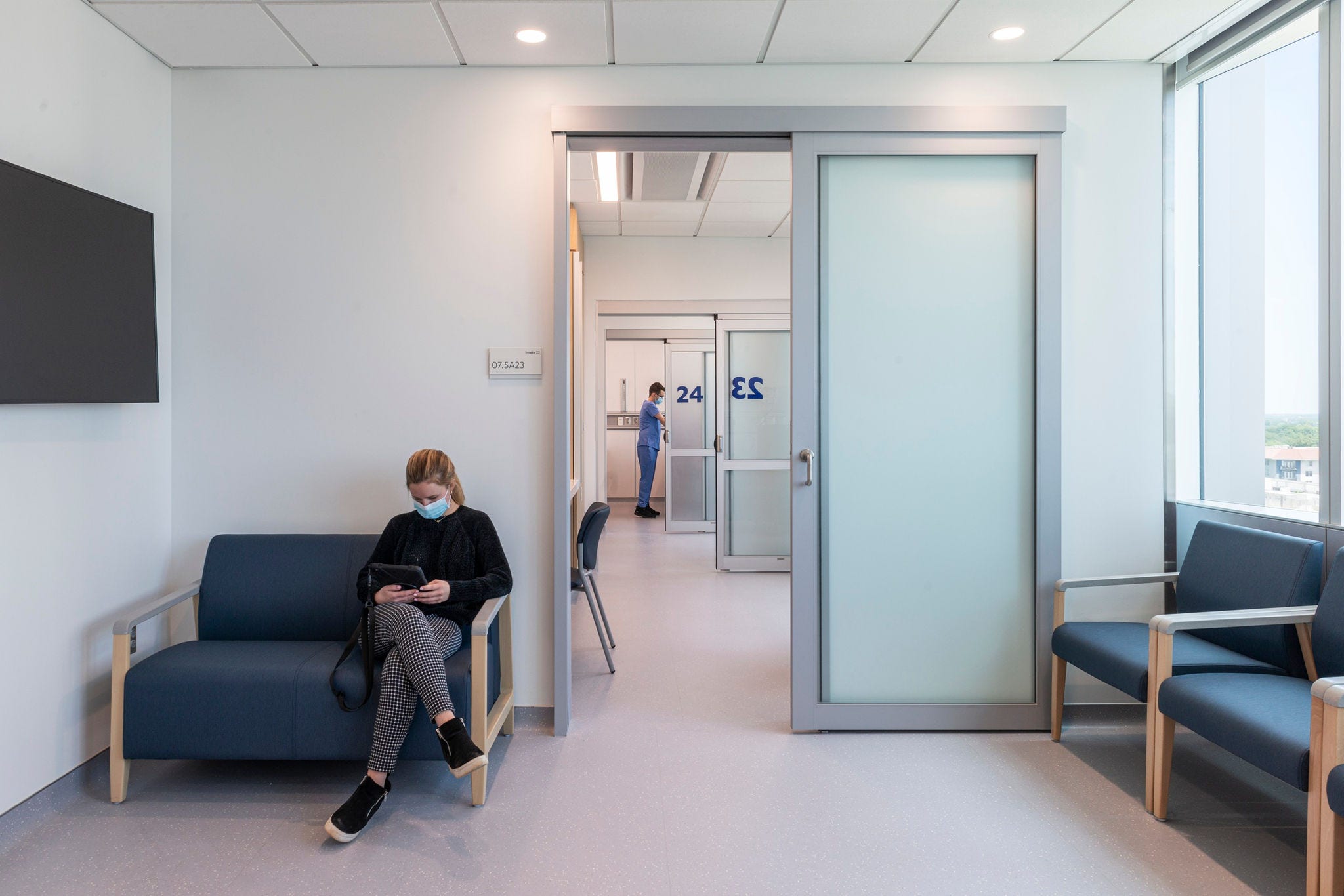
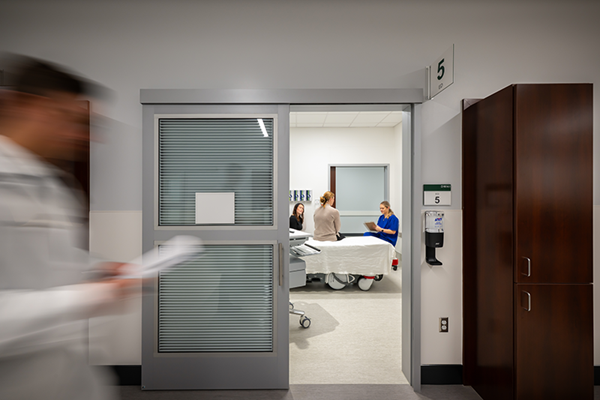
Sliding doors eliminate swing arc trajectories and minimize clearance requirements to support space-efficient and accessible interiors. In health care facilities, these opening systems contribute to a more flexible design by increasing potential opening widths without requiring the same footprint as traditional swing doors.
Over the years, commercial sliding doors have seen innovations that expand where they can be used—from fire and smoke ratings to telescoping systems and more. One innovation is the ability for these openings to meet radiation shielded door standards.
Lead-lined sliding doors answer the question do sliding doors work in X-ray rooms with a resounding yes. However, when specifying lead-lined sliding doors, it is important to understand how these openings are built, their application requirements, performance standards and other operational considerations.
What are radiation shielded doors?
Radiation shielded doors use heavy duty core materials like steel, concrete and lead, to block X-rays, gamma rays and other radiation from MRI equipment, X-ray machines and other specialty diagnostic tools. It is important to note that shielding core materials must often be incorporated into the entire opening system: the door leaf, the frame and any glazing used.
These specialty entries work in tandem with walls and radiation shielding glazing to minimize unintentional radiation exposure for health care providers and patients. How thick the lead lining should be depends on local code requirements, facility design best practices, the position and type of diagnostic tool, the location of the room and more.
Lead-lined door specifications: compliance and standards
Creating code-compliant radiology departments can be an extremely nuanced undertaking. Not only do needs shift depending on equipment but also the positioning of that equipment impacts requirements.
When specifying lead-lined sliding doors, design teams are encouraged to consult with a medical physicist or radiation safety officer and to confirm specific requirements with guidance from National Council on Radiation Protection and Measurements (NCRP) and the International Commission on Radiological Protection (ICRP). These professionals and regulatory bodies will recommend lead-lined door details to meet radiation shielding door code requirements based on:
- X-ray energy in peak kilovoltage (kVp)
- How often the room is used
- Who occupies adjacent spaces
- Beam direction and room layout
Radiation shielded sliding doors with a 1/16-inch lead lining will often suffice for standard medical applications, but higher-risk environments may require 1/8-inch, 3/16-inch or greater thicknesses. These materials should meet ASTM International standard ASTM B749-03.
After these calculations and recommendations have been made, it is extremely important for radiation shielded doors to be installed with precision. This includes:
- Minimizing gaps to acceptable measurements between the frame, door and wall
- Ensuring any glazing is impact-rated according to ANSI Z97.1 and CPSC 16 CFR1201 standards and labeled properly
- Confirming all hardware is appropriate for the weight and use of a lead-lined door
- Following all protocols for the proper handling and disposal of lead-lined components
Following these considerations will help project teams meet compliance standards when specifying lead-lined sliding doors.
Operational considerations for specifying lead-lined sliding doors
Beyond achieving radiation shielding door code requirements, design teams will often have to adapt standard door specifications to ensure an opening is functional and durable. This may include engineering more robust frames to handle the extra weight of radiation shielding core materials, incorporating hardware with higher weight and force tolerances, including optional hardware like indication locks and more.
Beyond being able to customize sliding door systems like ExamSlide™ with lead-lining, AD Systems can offer design teams trusted collaboration throughout the entire process. As a manufacturer and single-source supplier, AD Systems can support the design of radiation shielded doors and other openings within the built environment to facilitate a cohesive aesthetic and a more intuitively functioning building overall.
Collaboration streamlines lead-lined door detailing
By bringing in a trusted door manufacturer like AD Systems early in the process, design teams can have the peace of mind that a radiation shielded door will meet third-party test standards and be engineered to their exact specifications.
This collaborative approach to specifying lead-lined sliding doors can also help support other openings in a health care facility. With several types and configurations of commercial sliding and flexible opening doors available, AD Systems can help designers find appropriate opening systems for a wide range of applications.
Discover what the AD Difference can mean for your next health care project.
You May Also Like
Check out similar product solutions.
Read about our products in the real world.
See how our doors solve many challenges.




Want AD Systems in your inbox?
Sign up to receive product updates, news and information from Ives sent directly to your inbox.
Let us help.
Contact us today to talk about your project needs, or call us at 425.740.6011.



Ⓒ 2025 Allegion all rights reserved