


















Understanding the Glass Options for Commercial Sliding Doors
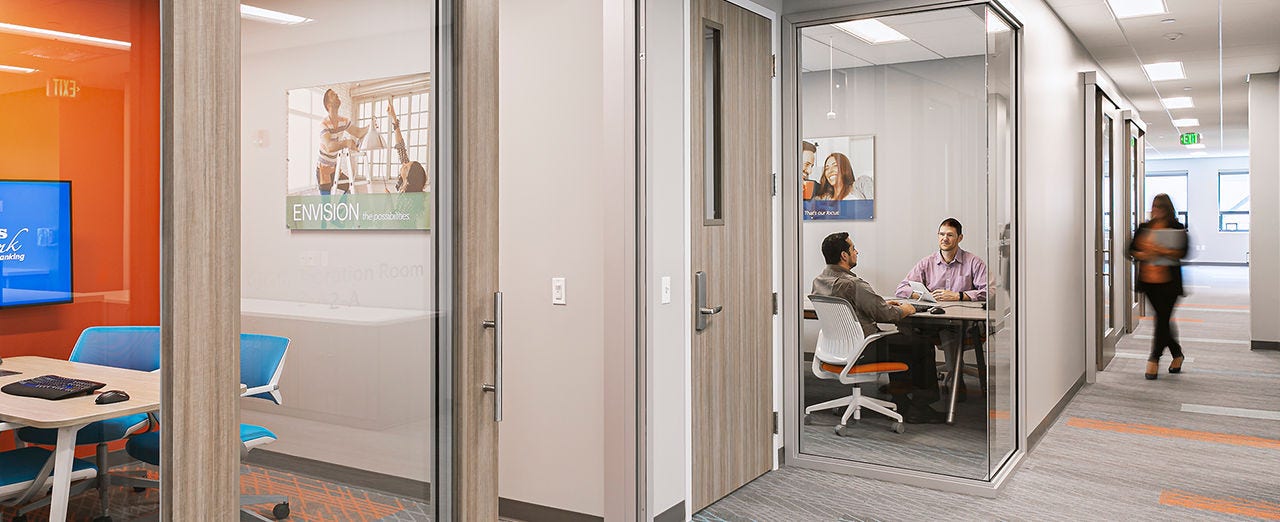
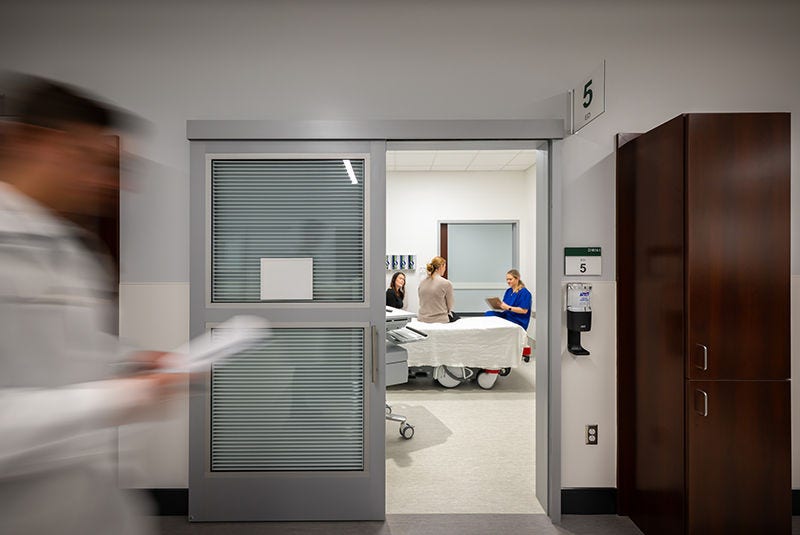
Phrases like “behind closed doors” or “a closed-door meeting” invoke the idea of privacy. Glass, however, can often conjure a sense of openness and visual connection. A full-lite commercial sliding door might seem like a contradiction, but glass doors are an increasingly popular feature in many office designs.
So why do businesses have doors that incorporate glass?
Often the reason is that, when closed, glass doors support visual connection while preserving acoustic isolation. This helps offices and commercial spaces achieve more flexible designs. When these projects incorporate commercial sliding doors with full-lites of glass, they can balance the benefits of open office floorplans with those of sectioned off plans.
As discussed below, using glass can be advantageous to many commercial designs, and commercial sliding doors expand where project teams can specify glass.
What are the benefits of glass in interior design?
Exterior-facing glass systems, like windows, walls and skylights, allow occupants to access daylight, which delivers several well-researched benefits to a wide range of project types. While interior glass doors only tangentially support daylighting strategies, they can contribute other benefits as well.
For instance, interior glass systems can support a more open office feel by extending sightlines between adjacent areas. Commercial sliding doors that incorporate large glazing areas and curtain wall systems allow designers to achieve the benefits of an open floorplan without the associated drawbacks—distracting noise, lack of a sense of privacy and more.
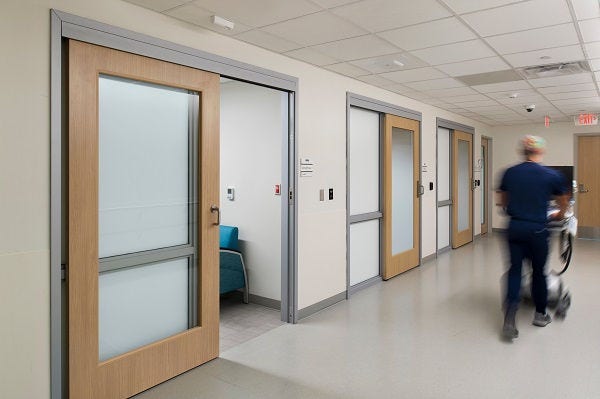
Full-lite, aluminum-framed commercial sliding doors can also be specified in wider-than-average sizes without requiring the larger swing arc trajectories associated with oversized swing doors. This furthers a floorplan’s flexibility since occupants can open a door to blur the line between spaces or shut the door for more privacy.
Customize commercial sliding doors for aesthetics and functionality
While some projects may value a more open office design, others may require both acoustic and visual privacy—whether that is partially or in full. Likewise, occupants may benefit from moments of privacy and moments of openness. In these instances, designers still have many options for balancing openness and privacy.
For example, the glass used in commercial sliding doors can be finished with frosted and decorative glass to obscure vision into a room. These door systems can even incorporate switchable privacy glass. When activated, this material becomes opaque for full privacy, and when deactivated, the glass becomes transparent once again.
There are also sliding door systems that can be specified with integrated blinds or louvers. With permanently sealed louvers or blinds between double glazing, these glass door systems allow occupants to control the level of visual connectivity at any given time. Because they are sealed within a door system, both integrated blinds and louvers require no special cleaning and are not easily damaged, easing ongoing maintenance demands.
Retain acoustic performance for a truly flexible design
It should be noted that in the past commercial sliding doors lagged behind traditional swing doors in terms of acoustic performance. However, sliding doors from AD Systems address this through the development of perimeter and drop-down seals. These systems can provide Noise Isolation Class ratings (NIC) of up to 39, which means they can dampen up to 39 decibels when installed. As a result, they can effectively turn a conversation on one side of the door into a barely audible whisper on the other.
When AD System’s doors are specified as aluminum-framed, full-lite glass doors, they allow designers to offer a truly flexible design—one that prioritizes privacy when needed and openness when desirable. In fact, these commercial sliding door systems with large glass panels and sidelites were specified for Peoples Bank in Munster, Ind., to balance openness while also maintaining confidentiality when employees discuss financial matters with customers.
Commercial sliding doors open a broad range of possible designs
With a broad range of glazing options, commercial sliding doors that readily incorporate large areas of glazing demonstrate why businesses have glass doors. These systems blend privacy and openness to offer multiple points of value to a floor plan. And, because they are customizable, project teams can design them to meet the specific goals of an individual project.
Start planning your next project’s ideal commercial sliding door system today and then contact AD Systems to learn how to turn these plans into finished buildings.
You May Also Like
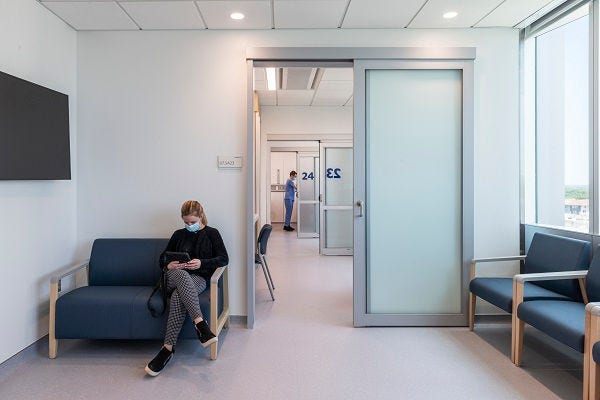
Check out similar product solutions.
Read about our products in the real world.
See how our doors solve many challenges.



Want AD Systems in your inbox?
Sign up to receive product updates, news and information from Ives sent directly to your inbox.
Let us help.
Contact us today to talk about your project needs, or call us at 425.740.6011.



Ⓒ 2025 Allegion all rights reserved