


















Know the Options: Specifying Flexible Openings for Health Care
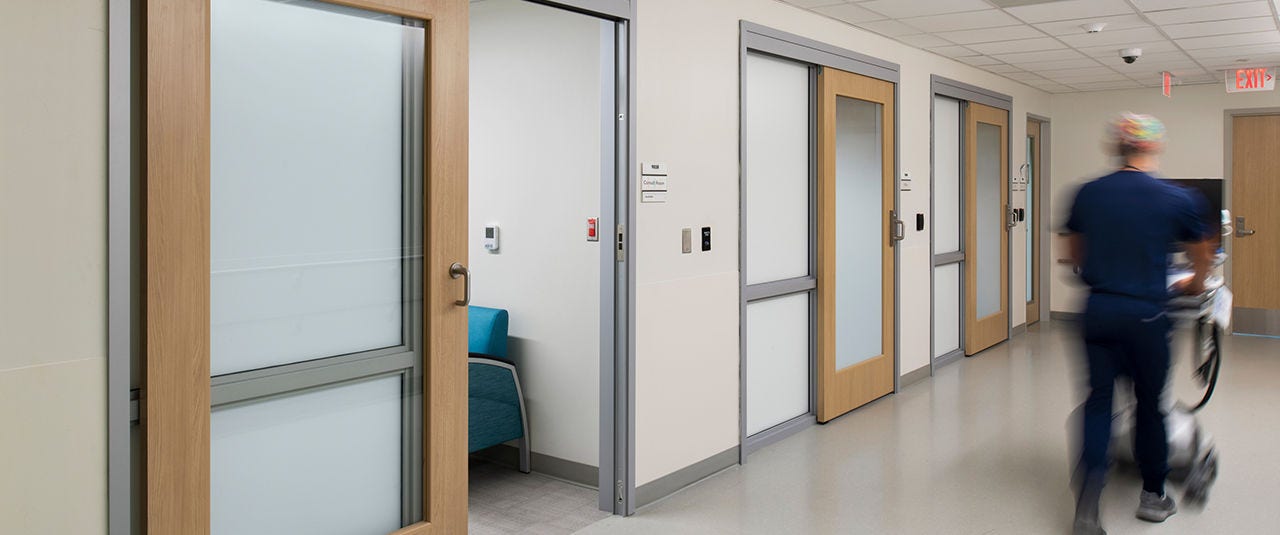
Design flexibility is a high priority in health care settings. Flexibly designed medical centers can easily adapt to sudden changes in patient needs and typically have a longer service life than buildings that are more static.
While there are many ways to incorporate design flexibility, openings can be a cost-effective means for increasing a project’s overall ability to flex into changes in use and need. Health care sliding doors can offer wider openings without requiring more room to accommodate swing arc trajectories. As a result, facilities that use these door systems can more easily adapt without needing extensive renovation.
That said, there are many flexible opening solutions on the market, which can cause uncertainty as to which option best fits a given application. The following questions and answers can help guide door specification in health care or start the conversation as to which are the best types of sliding doors for health care design.
Which commercial sliding doors are best for narrow corridors?
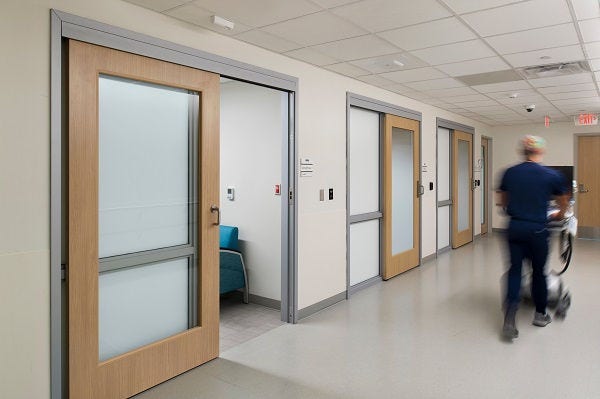
Corridors can be essential in health care flexibility. Hallways not only help facilitate the movement of patients and meet code-driven requirements for safety and accessibility, but they can also serve as storage areas for mobile equipment and overflow areas during high patient surges. As such, planning to minimize swing arcs and reduce door protrusion can be particularly important.
While surface-mounted health care sliding door systems can meet most project goals and building codes, there may be instances where they are not the best type of sliding door for health care projects. To minimize protrusion, designers use inset sliding doors. For example, a recently completed pediatric intensive care unit (PICU) incorporated InsetSlide™ from AD Systems to optimize space use and meet code requirements.
How can automatic sliding doors improve health care design?
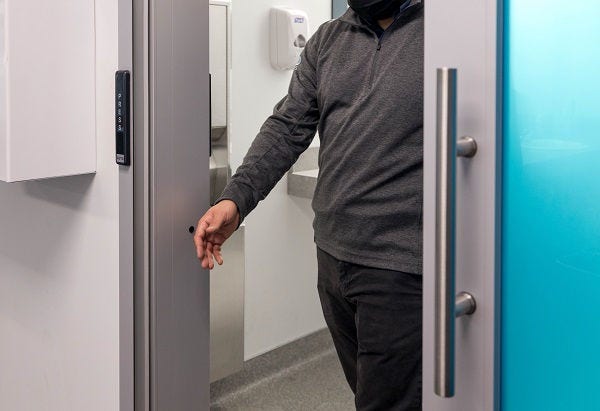
In addition to having multiple mounting options, health care sliding doors can also be specified with automatic openers. These door systems minimize touchpoints to improve building hygiene. They also readily meet opening force and closing speed requirements to support accessible design.
Automatic sliding doors can also aid in efforts to maintain stable pressurized environments. Because they open and close at a predetermined and fixed rate, their operation can minimize air turbulence normally associated with opening a door—a situation that can depressurize a room and risk breaking infection control protocols.
Why is it important to use sound-reducing doors in medical facilities?
Maintaining a quiet and peaceful environment is critical to ensuring both patient and provider health and wellness. Limiting sound transfer between common areas, workstations and patient rooms can help support a more restful hospital stay, which can be linked to improved patient outcomes. It can also mitigate alarm fatigue—a key consideration in a recently renovated Kentucky intensive care unit.
Options like ExamSlide™ can offer Noise Isolation Class (NIC) ratings of up to 39, which dampens up to 39 decibels of sound to effectively turn a normal volume conversation into a whisper.
How else can commercial sliding doors balance visual connection and privacy?
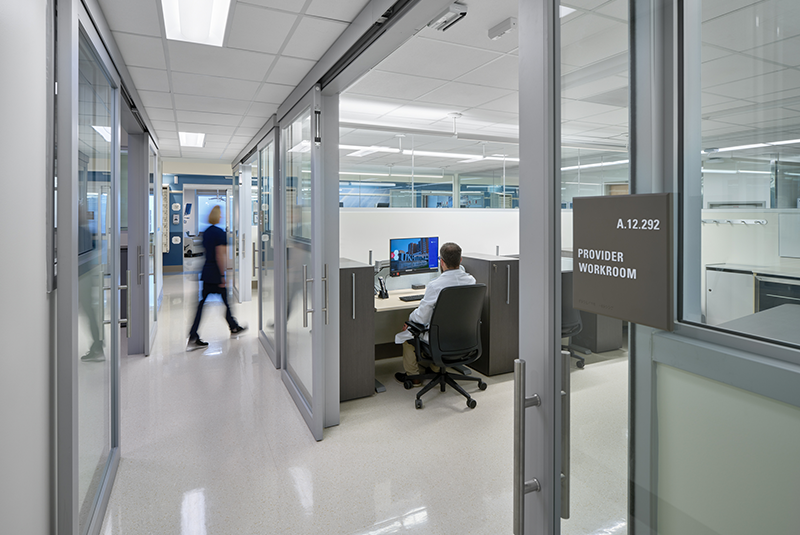
Although acoustic privacy can be essential for both patient and provider spaces, visual connection is often highly sought after as well. Visually connected spaces allow providers more vantage points to monitor patients, potentially increasing the level of care they can provide. It can also keep medical teams connected to mitigate feelings of isolation.
This last point was a request from the medical team at the University of Kentucky ICU. Full-lite, health care sliding doors support the goals of a visually connected and acoustically isolated ICU.
Determining the best type of sliding doors for health care settings relies on project goals
Every medical facility project faces its own unique challenges when it comes to creating a safe, functional and inspiring design. As a result, the needs placed on door solutions can vary significantly. This can be true when comparing whole projects or even spaces within one project.
Often, many opening solutions are required to create an optimal health care interior. When project teams collaborate with door manufacturers that offer a wide range of flexible opening solutions, they can streamline the planning and specification process.
You May Also Like
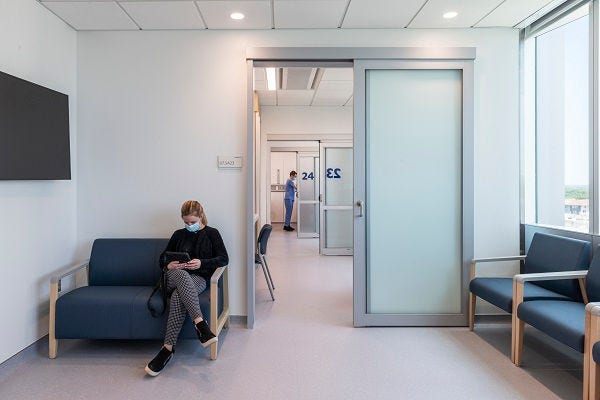
Check out similar product solutions.
Read about our products in the real world.
See how our doors solve many challenges.



Want AD Systems in your inbox?
Sign up to receive product updates, news and information from Ives sent directly to your inbox.
Let us help.
Contact us today to talk about your project needs, or call us at 425.740.6011.



Ⓒ 2025 Allegion all rights reserved